Friday, December 4, 2015

David Armand: An Interview with St. Tammany 'Rough South' Writer

by Donald G. Redman

David Armand
Photo courtesy David Armand
David Armand’s third novel, The Gorge, was released in October 2015 and early reviews are full of praise for the Louisiana native and award-winning author. Armand is among a new breed of writers whose works are classified as “Grit Lit” or  regionally as "Rough South" literature (rough-edged Southern Gothic primed for violence), influenced by the likes of Cormac McCarthy and Larry Brown.

Armand hasn’t forgotten his roots, his old stomping grounds in northern St. Tammany and Washington parishes play prominent roles in his novels. The geographical anomaly and horrific past of Fricke’s Cave in the Bogue Chitto State Park just south of Franklinton was the inspirational setting for The Gorge. Despite its name, Fricke’s Cave more closely resembles a gorge and it was there in 1980 that two ex-cons raped, tortured and murdered a young woman, which later served as the backdrop to Sister Helen Prejean’s book, Dead Man Walking, a biographical account of her relationship with one of the killers on death row.

In addition to being an established writer, Armand is a professor of English at Southeastern Louisiana University in Hammond, Louisiana, where he also serves as associate editor for Louisiana Literature Press. He received his bachelor’s degree in English in 2004 and his master’s degree in 2006.

In 2010, Armand won the George Garrett Fiction Prize for his first novel, The Pugilist's Wife, which was published by Texas Review Press. His second novel, Harlow, was published by Texas Review Press in 2013. Armand's third novel, The Gorge, was published on October 1, 2015, by Southeast Missouri State University Press, and his poetry chapbook, The Deep Woods, was published in September by Blue Horse Press. Armand's memoir, My Mother's House, is forthcoming from Texas Review Press.


Armand recently agreed to a Q& A session with The Redman Writing Project where he talks about his early influences and offers insight into his fiction and poetry.

What were your earliest writing experiences?

ARMAND: The first "real" writing I did was when I was in the third grade and wrote a comic strip for the "Just Say No" campaign. It was an illustrated story about saying "no" to drugs, and it won first place in a contest in St. Tammany Parish. I got a hundred dollars and they hung my winning piece up at the Parish fair. That was the first time I really thought I could actually do something with writing. I had always loved books and reading, so this was a nice motivator.

Did you write for the high school newspaper and did you keep a journal? Did you enter any writing or poetry contests in school? What did you do to foster the writing bug?

ARMAND: I never did write for the high school paper, though I had always wanted to. I just didn't have the motivation as a teenager to talk to the right people to make that happen. Same with poetry contests. I was writing poems in high school, but I just kept them to myself mostly. I wish I had participated more when I was in high school, but I was sort of a loner. I liked to write stories and poems and other sketches, which I kept in notebooks and on scraps of paper in a shoebox. One day, I got so discouraged with the work, I burned it all. Maybe it was a good thing I did because I doubt, now, that any of it was any good.

At what point did you decide you wanted to be a writer? Was there one teacher, one influence or was it just an accumulation of events?

ARMAND: I think it was really just an accumulation of events, and a good deal of luck as well. As I've said, I've always loved reading and writing from when I was a small boy, so it just seemed natural to me that I would start writing my own stories. It wasn't until I got to college and started studying creative writing that I learned how I could do this professionally. 

How did you get your first start? What was your first published piece?

ARMAND: My first published piece was a poem that appeared in the undergraduate creative writing journal at Southeastern Louisiana University, where I went to college. I was writing a lot of poems then, so it was nice to get a couple of them in print. I was submitting poems all over the place then, getting a lot of rejections, so it was nice to get an acceptance.

Tell us about your poetry:

ARMAND: The poems I've been working on lately are generally about my family. They're simple narrative poems, but ones I hope lend themselves to multiple readings. I hadn't written a poem for over ten years, so it was refreshing to return to that form again. They're a nice reprieve from the intensity and time spent writing novels. 

Tell us briefly about your novels:

The Fricke's Cave boardwalk at
Bogue Chitto State Park

Photo by Donald G. Redman
ARMAND: My novels all take place around Folsom, Franklinton, Bush, Sun, and Amite, Louisiana. These are the places with which I'm most familiar and for which I still hold a deep fascination--the people, the landscape, etc. All three of my books deal with people who are desperate, whether it be desperately in love, desperate for escape, desperate for acceptance, and also the idea of maintaining hope in the darkest of situations. I like to think of these novels as a sort of trilogy, even though they're not dependent on one another plot-or-character-wise. 

Asked which of your three novels I should read first, your wife immediately responded, Harlow. Why?

ARMAND: I think I agree with my wife that Harlow is the best exemplar of my work and what I'm trying to do with language and my expression of hope in the face of despair. It's also the most personal of my books, as it is based loosely on my own experience searching for my biological father and the disappointment I had when I did meet him. I was surprised by how many readers have approached me and told me they could relate to this story. I think because it was so personal to me, that it resonated with others. 

Most writers will tell you that there is a particular time of the day they feel they are most creative and do most of their writing. When do you do the bulk of your writing?

ARMAND: Well, I write all the time. Whether I'm physically at the keyboard or not, I feel as though I'm always writing--taking mental notes, observing people, paying attention to conversations, etc. That's part of writing to me--listening and watching, being observant. Also reading constantly--I think doing both of those things are ultimately more productive than forcing yourself to sit in front of a keyboard for four hours a day or whatever. That can produce a lot of uninspired work. I'm more concerned with quality over quantity. When I'm working on a project, though, I try to write every day until it's finished, simply so I don't lose momentum. 

What was the biggest lesson you learned while writing your first novel?

ARMAND: I learned the self-discipline it takes to devote oneself to a project that can take years of one's life with no promise of any reward (in the case of a novel, of course, the reward would be publication). I also learned that I have that self-discipline and patience to keep doing it. Additionally, I learned how to cut--my first novel, as well as my third one, were cut nearly in half before they were ultimately published. I have filing cabinets full of pages that were cut from my novels. 

What advice would you give to novice writers or even those unpublished writers still slugging it out?

ARMAND: I would just say to keep slugging it out. Find some folks to read your work who will give you honest feedback, then keep working on it. At some point, start sending it out. Don't be discouraged by rejections--they're inevitable. Use them to motivate you. Go take a look in a bookstore at some of the books being published and find ones that you think aren't any good. It's OK to tell yourself that, "if this book can get published (whatever book it is), then mine can, too." 

What are your interests? How do you incorporate your interests into your writing or how have they influenced your writing?

ARMAND: Spending time with my family, reading, and watching movies. One day, I'd like to do a lot more traveling. My writing is definitely influenced by film in the sense that I think about things like mise en scene and trying to make my stories cinematic without losing the poetry of the language. I love directors like Quentin Tarantino, the Coen brothers, and David Lynch. My books definitely try to pay homage to them and the work they've done for the screen. 

What are you writing today?

ARMAND: Right now, I'm working on another novel, The Lord's Acre, which is about a religious cult here in Louisiana. I'm also thinking about collaborating with an artist friend of mine on a graphic novel and also maybe writing a screenplay. 

Where can people find your work and where can they follow you?

ARMAND: Of course, folks can order my books from Amazon or directly from the publishers. They can follow me on Twitter or Facebook by going to my website: davidarmandauthor.com

List five of your favorite authors:

ARMAND: Cormac McCarthy, John Steinbeck, Stephen King, Larry Brown, and William Faulkner


List ten books you’ve read that you’ll never forget:

ARMAND: The Road by Cormac McCarthy, East of Eden by John Steinbeck, 11/22/63 by Stephen King, Dirty Work by Larry Brown, Light in August by William Faulkner, Maus by Art Spiegelman, In the Place of Justice by Wilbert Rideau, Cold Mountain by Charles Frazier, The Liar's Club by Mary Karr, and Deliverance by James Dickey.

What are you reading right now?

ARMAND: I'm reading a few different things: Every Love Story is a Ghost Story, which is a biography on David Foster Wallace, Blood and Grits and Madonna at Ringside, two books of essays by Harry Crews, Dynamite, a book of poems by Anders Carlson-Wee, and Trashed, a graphic novel about garbage collectors. My reading taste is very wide-ranged lately. I read everything.


Would you be willing to grant us permission to reprint a poem of your choosing on our blog?

 ARMAND: Yes. "Photograph of My Father" is one of my favorites.

“Photograph of My Father” 
by David Armand
You’re standing in the kitchen of that old trailer
that you rented for us on Davidson Road
and where we lived for a couple of months
while you cleared some land just north of here in Folsom
to put another trailer that you were going to buy brand new.
I remember that one of the toilets in that old place
never flushed right and the whole trailer leaned
on its cinder blocks so that all the doors inside
hung wrong and they would creak open
in the middle of the night sometimes.
But there was a horse paddock in the front yard,
a couple of stalls where once I watched
you help deliver a colt and where another time
I saw you get kicked in the chest by its father.
There was also a great field where we rode Go-Karts
and where one time you pulled my brother and me
behind your truck on our scooters
with a piece of rope you found in the shed.
We hunted quail back there in that field too,
pitched baseballs, shot bows and arrows
at little paper targets. And we went fishing
in a pond that was on another man’s land.
That’s where you caught the fish you’re holding
in this picture. It’s a bass that for some reason
you called “Walter.” Its silver scales and wide mouth
are open around your closed hand and its caudal fin
comes all the way down to your belt—
I swear that fish must’ve been three feet long.
You’re smiling about as much as you ever did here:
your teeth aren’t showing. Just a tight, hard grin
that’s barely visible beneath your beard
and your beer-reddened face and cheeks.
You’re also younger in this picture
than I am now, probably by at least five years,
and have only a dozen more left to live.
But of course you don’t know that here.
How could you?
Behind you the counter’s covered with grocery bags,
a box of Frosted Flakes, some pots and pans
and their lids. There’s a sugar bowl, paper towels
a couple of two liter bottles of Coke, a coffee maker.
You’re standing in front of that counter
and just to the right of a dingy yellow refrigerator
wearing dark jeans and green hospital scrubs
that you got when you went to the Emergency Room
after you nailed your hand to a rabbit cage that time.
Do you remember that?
Anyway, this fish you’re holding is staring out
past your thick, dark arms, past the mess
of our kitchen and the mess of the life you built
for us but that was still somehow pretty good.


Photo copyright David Armand. All rights reserved.
"Photograph of My Father" copyright 2014 David Armand. All rights reserved.
Copyright 2015 Donald G. Redman. All rights reserved.

Tuesday, December 1, 2015

An Interview with Playwright Rob Florence

by Donald G. Redman

Rob Florence is originally from New York and moved to New Orleans in 1987 only to discover that his father’s family had been in the region since the 1840s. “In doing family genealogical research I discovered the wonders of New Orleans aboveground cemeteries,” says Florence. “In some way, most of my plays are connected to New Orleans cemeteries.”
ROB FLORENCE
Photo by Steven Forster, NOLA.com

He received a Masters in Playwriting with distinction from the University of New Orleans in 2008 and is the Dramatists Guild Gulf Coast / Mississippi Delta Regional Representative.
His body of work includes: Bones; Burn K-Doe Burn!; Mirrors of Chartress Street; Fleeing Katrina; The Key and Holy Wars.

I caught up with Rob Florence for an interview on the eve of Slidell Little Theatre's production of Katrina: The Mother-in-Law of 'em All on the 10th anniversary of Hurricane Katrina.

What was your relationship with the K-Doe family?

FLORENCE: I was fortunate to have a close relationship with the K-Doe's, as they were extraordinary people.  I knew Ernie K-Doe back in the 1980s when his drinking problem was so bad that he would sometimes sleep on the street.  I saw Antoinette come into his life, literally pick him up out of the gutter, sober him up, and add years to his life which turned out to be an amazing experience for the many people who shared it with them.  They opened the Mother in Law Lounge which was their home, so when you were at the bar you were in their living room.  The place was a shrine to New Orleans R&B, full of dazzling, eccentric memorabilia.

Like the K-Doe's themselves, the Lounge was surreal.  The K-Doe's shared my interest in New Orleans cemeteries.  We had a cemetery preservation group called Friends of New Orleans Cemeteries.  Ernie K-Doe was the grand marshal, making us the only preservation group in the world with a grand marshal.  I was responsible for burying both Antoinette and Ernie in the historic St. Louis Cemetery #2 and wrote the text for their historic markers.  Antoinette K-Doe asked me to write a play about them called BURN K-DOE BURN! and she asked me to write this piece about her Katrina experience.

What was the genesis of “Katrina: Mother-in-Law of ‘em All?”

FLORENCE: Although I'm a playwright and writer of nonfiction which focuses of this region, Katrina was the last thing in the world I wanted to write about.  I wanted to put it out of my mind, which was of course impossible, but I certainly didn't want to live with it 24 hours a day as you do when writing about something.  However, in listening to people over the subsequent months and years, I'd occasionally hear stories which were so different from the popular narratives that they compelled me to write them.  The differences that struck me in these stories were that although all these people went through hell, they landed on their feet in a very strong, defiant, New Orleans way. 

They also in many cases got through their experience with humor, which is very New Orleans.  If this experience had happened to another city I don't think I'd have found narratives that are so funny.  Something else these stories emphasize is that despite how the region was portrayed – defeated, chaotic, criminal – anyone here at the time can tell you that thousands of people were behaving in exemplary ways.  Strangers were helping strangers –  countless acts of self-sacrifice, compassion, and kindness that seemed to be hidden from people outside the region.  So part of this project was an attempt in a small way to create a record from the inside-out which establishes that post-Katrina New Orleans wasn't all what people were seeing on television, as this dialogue from the play illustrates:

RODNEY
So I go back into the room where my folks are and they had run into some of the people who had been on the roof with us. So there was this group of octogenarians but with only one cot and they were taking turns lying down. The young folks were trying to help the nurses, handing out water, taking people to the bathroom, changing diapers, whatever we could. We had heard all these horror stories about the city so I walk over to this nurse I see from Alaska and say, “I just want to let you know how thankful we are that you’re here because we keep hearing these stories about horrific things going on all over New Orleans and I just want you to know that the whole city isn’t populated by crazed lunatics who are burning it down and that we appreciate your -
 NURSE
Nobody thinks that.

You write that these are based on true stories. How did you come to learn these stories? 

 FLORENCE: I think I was fortunate to access these stories because I wasn't looking for them. Again, I was trying to mentally escape from Katrina.  But like everyone else here for the past 10 years, I've been listening to hundreds, maybe thousands, of these experiences.  So the stories kind of came to me.  At the time, there were writers parachuting into the region with tape recorders looking for material, which struck me as odd with all the work that needed to be done.  Could you imagine going to Haiti after the earthquake with a tape recorder looking for stories with all the death and destruction that needed attention?  For her PhD in Theatre History at L.S.U., Anne-Liese Juge Fox wrote a paper on Katrina plays written by regional writers as opposed to out-of-state writers.  She concluded that out-of-state writers, "Cut your heart out, put it on a plate and ate it in front of you," whereas the regional playwrights humanized the people of this region through their Katrina experiences.  

How were you personally affected by the hurricane?

FLORENCE: If I were to sum up in a few sentences what happened to my life during Katrina, most people outside of here would say, "That's horrible!"  But compared to so many people I ultimately did much better so I don't like to dwell on negative things that happened to me back then.  And moving-on is a characteristic I see in New Orleans people and which people have identified in this play.  About an earlier version of this play which went to the Kennedy Center American College Theatre Festival, one of the KCACTF adjudicators commented that the characters aren't self-pitying, which is compelling for the audience.  I guess as bad as their experiences were to begin with, they were still alive?  David Hoover, director of that U.N.O. production, commented on this lack of self-pity by comparing it to Vietnam War plays which David summed up like this:  "O.K., I'm going to tell you about my pain.  Alright, get a little closer, because you need to know about my pain.  O.K., here comes the story about my pain:  YOU CAN'T UNDERSTAND MY PAIN!!!"   

Some of the positive effects of Katrina have been that although I've always loved the people of New Orleans, Katrina made me love them much more.  The devastating human failures of Katrina were governmental but on a local level many people conducted themselves heroically. And we all know how fantastic the rest of the country and people from other countries have been to us for the past 10 years.  So although Katrina made me deeply cynical and bitter toward all levels of government, the experience actually made me feel better about individual human nature.  

ERNIE K-DOE and ROB FLORENCE
Photo credit: The Times-Picayune


The interview with Rob Florence originally appeared in Slidell Little Theatre's e-zine, Prologue, an audience guide to Katrina: The Mother-in-Law of 'em All and on the theatre's blog. Learn more about the late Ernie K-Doe here.


Wednesday, January 7, 2015

Reflections - by Donald G. Redman

Illustration by Donald G. Redman

Reflections

By Donald G. Redman

Peering in shop windows
She sees reflections of her beauty –
Reflections you wouldn’t see –
Reflections of Marilyn Monroe
And youth.
Shiny, pretty reflections
of desire.


Reflections' was created by repurposing an article by Sarah Bonnette in the north shore edition of the Times-Picayune featuring the artwork of Lory Lockwood.


Copyright 2015 Donald G. Redman. All rights reserved.

Thursday, December 18, 2014

Where the Natural World Stood

'The Almighty Hand' by Rebecca Rebouche
Photo by Sarah Bonnette, Times-Picayune

The Unlikely Naturalist
by Donald G. Redman

Her magic was unveiled
on a warm night In November.
Twinkling lights led
along a wooded path
to a clearing
where gothic creatures are standing in for
humanity.
Birds and fish swarm together,
zebras fall from the sky,
foxes carried on the back of a buffalo.
I feel the beauty and the profound meaning
of the world,
her supernatural face
brightly colored.
I visualize swans at night
And stars falling to the ground;
The world in pieces,
pouring into the shore.


'The Unlikely Naturalist' was created by repurposing an article by Sarah Bonnette in the north shore edition of the Times-Picayune featuring the artwork of Rebecca Rebouche'.

The inspiration behind blackout poetry comes from Austin Kleon.

First draft attempt:
It was a night full of magic/with twinkling lights vodka and cocktails./Musicians/in the clearing/Waited./An ethereal scene/200 people Hanging/where the natural world stood./Creatures standing in for/humanity
dream-like,/birds and fish swarm,/zebras fall from the sky,/foxes carried on the back of a buffalo./I felt the beauty and the profound meaning/Of the world./Her supernatural face unveiled,/A brightly colored hand struck me,/the tip of each finger containing swans/Eyes all around but only two are visible/I visualize swans at night and all the stars falling/To the ground

And:
 It was a night full of magic/in the clearing/Gothic creatures are standing./birds and fish swarm,/zebras mingle with whales,/foxes carried on the back of a buffalo./I felt the beauty and the profound meaning/Of the world.
I observe her face and/can’t sleep because/I visualize swans at night and all the stars falling/To the ground

And:
Her magic was unveiled/On a warm night/in a horse pasture../Twinkling lights led/Along a wooded path/To a clearing./Musicians had been camping/And sharing/Food and vodka and stout./They were the reason/200 people had come to the woods./Gothic creature standing for humanity./Birds and fish swarm together,/zebras fall from the sky,/foxes in trees/A swan carried on the back of a buffalo./I felt the beauty and the profound meaning/of the world./Then the Almighty Hand struck me./I can’t sleep./I visualize swans at night/And the stars falling to the ground,/The world a piano turning into birds./Human existence gone/And I am better for it.

Copyright 2014 Donald G. Redman All Rights Reserved

Tuesday, December 9, 2014

Cowboy Sailor - a poem

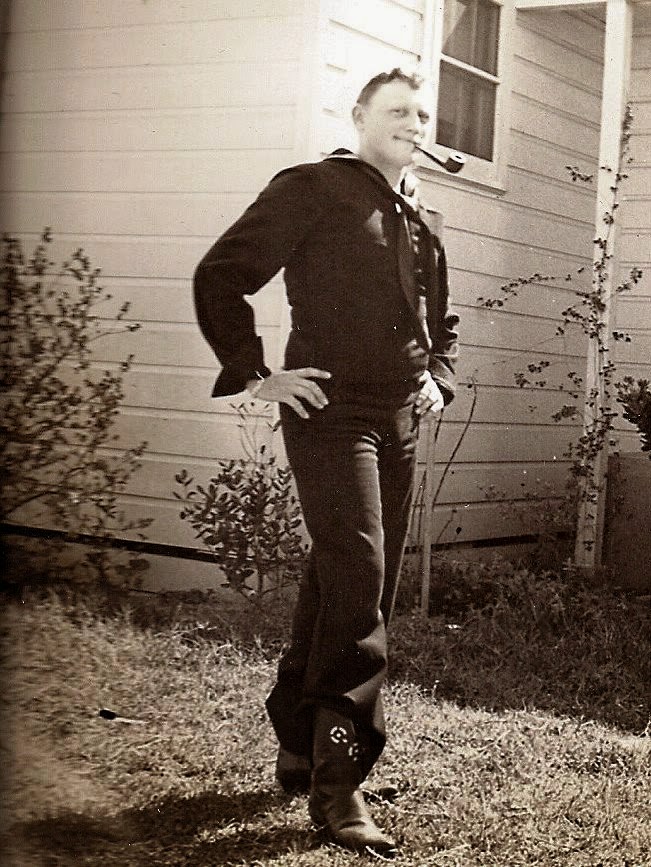
E. Valjean Redman
1941


Cowboy Sailor
By Donald G. Redman

I found an old black & white of you -
You’re about twenty best as I can tell -
Cocksure in your Navy blues,
Hands on hips like a fashion model,
Bell bottoms tucked loosely
Inside a pair of cowboy boots.
A style of rebellion, maybe
Or just showing off those leather beauts?
Curls peeking under the Dixie Cup;
Puffing wisdom from a Canadian pipe.
You look ridiculous in that getup
And yet somehow rakish, the archetype
Of all young men off to war before
Knowing the horror of war.

An image of you so far-flung
From the old man residing in my mind -
My father, so incredibly young
And brash and unconfined.

I sift through time for your words
Like an archaeologist sieving
Sand dunes for ancient potsherds
Words of dismay, still disbelieving
The ravages of the relentless clock.

Having glimpsed your own reflection
You told me of your outright shock
Of having aged without detection.
The mirror reflected an old man;
You said that was impossible
For inside lived a much younger man -
A man still vigorous and vital.

I agreed with the mirror’s projection;
Standing before me was not a man of youth
But a relic from an ancient generation
How could you be so blind to the truth?

You’ve been gone for many years now
And I watch silently as time adds
New lines to my face as with a plow,
Carving up my youth with an adze.
I hear anew your lamentations
Understanding now that you had no choice
But to succumb to the depredations
Of time without consent or a voice.

The old man still lives large within -
I love the old you, I truly do -
But age has cleared my mind’s vision
And I can see the cowboy sailor, too.

You there, young buck in the photo,
With your arms akimbo
Like a comic book hero,
Where o where did you go?


Copyright 2014 Donald G. Redman All Rights Reserved.

Tuesday, November 25, 2014

‘No Hurricane Waltz” – by Richard Boyd


No Hurricane Waltz
By Richard Boyd

Come timidly, rippling, squalling you pesky wave,
Dimpling and dipping maybe off Cape Verde Isles,
Sashaying innocently up from deep South Atlantic
And swelling ever deceptively at the open mouth:
Go west into the Caribbean Sea or beeline north?

Ah, you rollicking, wretched monitored little wave,
Settle down, now relax and go ever now gently
Across the vapid placid expanse of some old Gulf.
We embrace you undulating swells, we fondly do,
We chart your hoped for benign and steady progress.

Away, cascade away from Rigolets you timid wave,
Reject any big ideas from some misguided sea energy
And do not spew those waterwalls of churned anger
To surge across the calm face of our beloved old lake
And invade our waterfront and sanctity of our homes.

But we cringe, shudder from your oft howling anger.
Be not this time that scowling and slashing creature.
O, yes, now that is the admired correct way of wave.
Yes, go waltzing dear, hug fondly the calmer ocean,
Just a two step pleasing dance this sweet wave ripple.

Yes go slowly now, grand ballroom gestures abound,
Swirling skirts of mild foam topped dancing partners,
The rhythmic journey with the cold northern ocean
And we smile in relief of that dancing into oblivion.
Let no hurricane besmirch this splendid watery waltz.


Copyright Richard Boyd, 10/12/2014. All rights reserved. Reprinted here with permission.


Richard Boyd's poem, “No Hurricane Waltz” 
was the first poem selected to appear
in a new art project in Mandeville, La. 
poetry boxes – tiny public displays of work
 designed to encourage passersby
 to stop and appreciate poetry.
Photo by Donald G. Redman

Richard Boyd: A lifelong passion for poetry

By Donald G. Redman
 
Richard Boyd
Posing by a new Poetry Box stationed
on Mandeville's Lakefront
Photo by Donald G. Redman
NOTE: I first met Richard Boyd in the early 1990s. I was a cub reporter for a small town daily and he was a grizzled journalist covering the same small town, but for a much larger metropolitan newspaper. Despite the competitive nature of our business, Richard was always a kind and gracious man with a charming sense of humor. And he wrote some of the best ledes I’ve ever read.
Over the years and through career changes, I still managed to run into Richard every now and again, but in a different capacity – he as a poet and the unofficial curator of the Dew Drop Social and Benevolent JazzHall in Mandeville, La. In fact, it was at the Dew Drop that I caught up with Richard again and discussed music and poetry. His poem, “No Hurricane Waltz,” was selected as the first poem to be displayed in a new art project – poetry boxes – the first of which is stationed on the Mandeville lakefront with more planned for throughout the community. He graciously agreed to an interview with The Redman Writing Project.

RWP: What were your earliest writing experiences?

BOYDI started writing song lyrics around 1954-55 when I was 12-13 years old and listening to the radio. I would write lyrics with specific rock ‘n’ roll singers in mind. At Perkinston High School in Perkinston, Miss. I was editor of the Bulldog Barks in my junior and senior years. It was the Perkinston Jr. College paper actually, but the school asked me to be editor because those two years no college students were interested. Then I went on to Perkinston Jr. College for two years and continued as editor. I had some poems published in some student collections in high school but no longer recall those details.

RWP:  At what point did you decide you wanted to be a writer?

BOYDI don't recall ever thinking I wanted to ever do anything else but write. My mother was a writer for the Biloxi-Gulfport Daily Herald so I think she was the major influence and through her I was able to intern at the Daily Herald for four years of high school doing mostly sports, some general news and I also got paid to attend high school sports in upper Harrison County and file stories on scores. I was born in Gulfport on June 19, 1942 and from third grade on was raised 18 miles north of Gulfport.

RWP:  Did you fall into poetry or was it the other way around – you were a poet who fell into journalism?

BOYDMy early years of writing song lyrics in the early 1950s soon evolved into writing poetry on topics beyond the scope of pop songs. Throughout  high school and college (I also attended and got degree at the University of Southern Mississippi) I always wrote poetry and over 55 years as professional journalist I always wrote poetry. I probably write more now since retiring 6 years ago after 31 years with The Times-Picayune.

RWP:  Tell us about your poetry:

BOYD Much of my poetry reflects my deep appreciation of nature and my deep interest in music, rhythm and the flowing vapor of the finely wrote and delicate line that will come quietly and often vanish like the vapor if not captured during its brief appearance.
  
RWP:  Most writers will tell you that there is a particular time of the day they feel they are most creative and do most of their writing. When do you do the bulk of your writing?

BOYDI do most of my writing in early to late afternoon sitting on my front porch in my rocking chair sipping on glass of red wine and writing in longhand in a yellow legal pad. I retype and edit and rework poems on the computer and keep them stored in an office program on my computer but I cannot compose originally on a computer. Old school for me -- all my poems began as handwritten on pages of legal pads and then later typed into and saved on my computer.

RWP:  What is the most difficult aspect of writing for you?

BOYDCarving out time to turn off all other influences and just concentrate on poetry made more difficult since I retired by my involved in more civic activities than I should be volunteering to do.

RWP:  What are you writing today?

BOYDGot beginnings of a couple of poems to work on this afternoon.

RWP:  What advice would you give to novice poets?

BOYD I tell novice poets to write as much as possible and to find outlets to read their work to others in poetry reading groups. I have moderated poetry readings at 5 different locations in western St. Tammany since 2000 and now belong to a group Poets! Alive! that meets near Madisonville the fourth Saturday of each month.

RWP:  Tell us your involvement in Dew Drop.

BOYD:  With the Dew Drop as a reporter for 10 years in the St. Tammany Bureau of The Times-Picayune I early upon arriving on the north shore became aware of the old building and started doing research and soon got directed to documentation about it in university collections in New Orleans and started writing various stories about it. My goal was to try to rekindle interest in the city of Mandeville to officially acknowledging this historic shrine and making sure it endured. Shortly after I retired, then Mandeville Council members Trilby Lenfant and Zella Walker created the non-profit Friends of the Dew Drop and asked me to be a charter member, which I agreed with delight to become. I have stayed with it ever since and helped write the application that got it National Register of Historic Places status and now I book most of the spring and fall shows, sell our merchandise and just volunteer for anything involving the Dew Drop.

List five of your favorite poets and or authors:

BOYD:  Favorite 5 poets: Ezra Pound, ee cummings, Jack Kerouac, T.S Eliot, Andrienne Rich 


List ten books you’ll never forget:

BOYD:  10 books: The Cantos by Ezra Pound; Wasteland; all of Jack Kerouac; Dune Trilogy; Alexandria Quartet by Lawrence Durrell; most of Zane Grey; Intruder In The Dust by Faulkner; poetry of W.B. Yeats; poetry of Robert Burns; Treasure of the Sierre Madre by B. Traven.

RWP:  What are you reading right now?

BOYD:  Reading now The Poem of a Life, a biography by Mark Scroggins of Louis Zukofsky, a poet and contemporary of Kerouac, Ginsburg and the Beats in New York City in the ’50s.

RWP:  Where can people find your work and where can they follow you?

BOYD:   I really do not have my poetry posted anywhere.  But anyone in the area who wants to hear me read can come to Christwood Retirement Center from 2:30-4:30 pm last Saturday of each month for readings by us in Poets! Alive! group.